The question usually arrives as a preference. Someone has always wanted to sail, or has seen a catamaran in a friend's photographs, or assumes a motor yacht is the serious option. Each of those is a reasonable place to start. None of them is the right question.
The right question is what the week is for. Who is coming, how much of the time they want to spend moving, how far apart the places are that they want to see, and whether the boat is meant to be part of the holiday or the way of reaching it. Answer that and the type of boat usually chooses itself.
What follows is drawn from the fleet we charter: seventy-four boats, of which forty-seven are motor yachts, fifteen are catamarans and twelve are sailing yachts. The figures below are theirs, not a brochure's.
The catamaran: space, stability and shallow water
A catamaran is two hulls joined by a bridge deck, and nearly everything that makes it good follows from that. Ours measure between twelve and twenty-three metres, and their beam is roughly half their length. A monohull of the same length is a quarter to a third as wide.
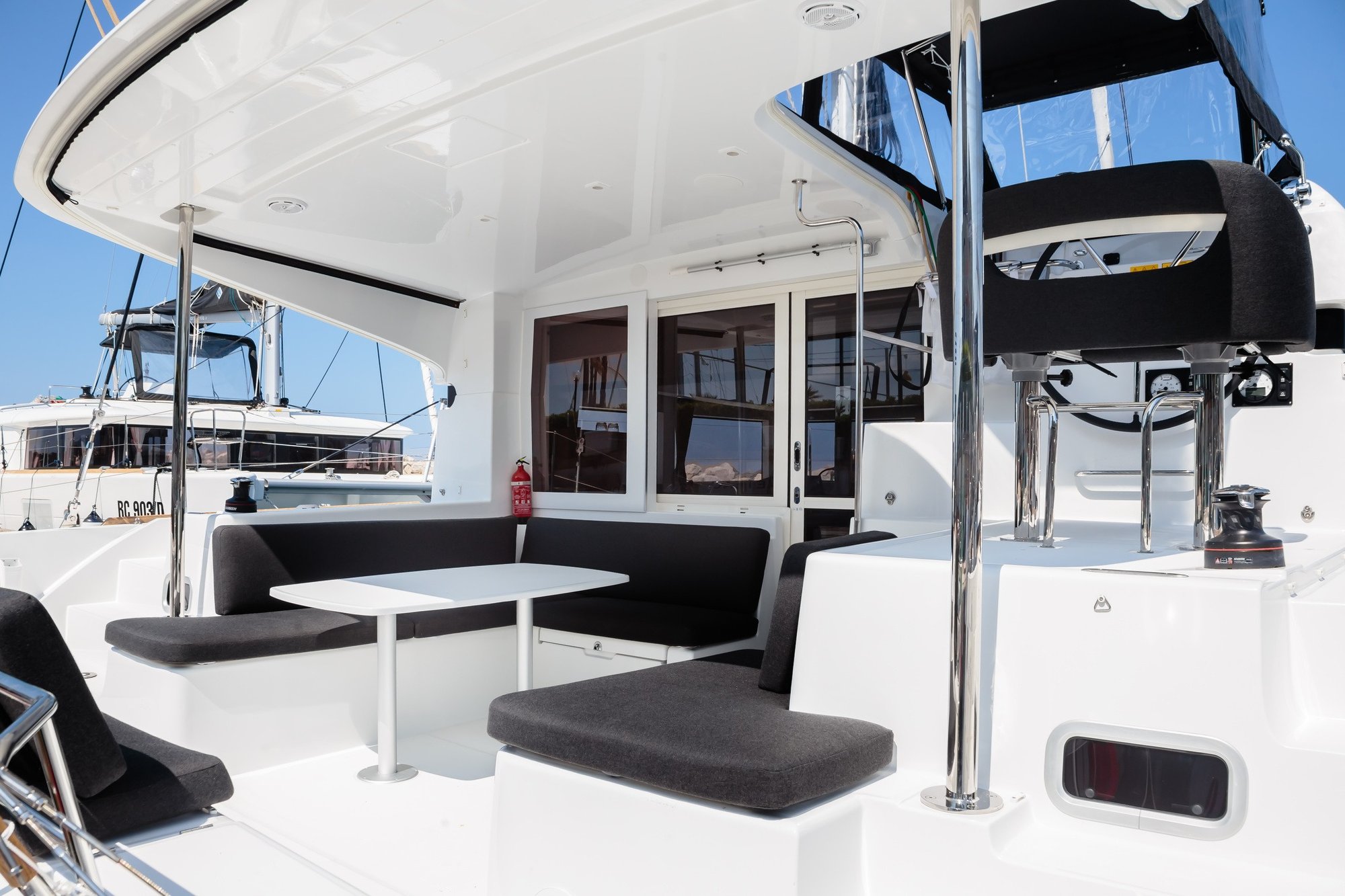
That width is floor. The saloon and cockpit sit on one level, and there are usually two or three separate places to be outside — aft, forward and on the flybridge — so a group can spread out without anyone going below.
It is also stability. A catamaran does not heel under sail and rolls far less at anchor, which is the thing first-time guests notice most, and the reason families with young children and anyone prone to seasickness tend to be happiest aboard one.
And it is draught. Our catamarans draw between one metre twenty-five and one metre sixty, against two metres or more for the sailing yachts. In the Egadi, around La Maddalena and along the Aeolian coast, that decides whether you anchor in the bay or outside it.
The trade-off is character. A catamaran sails well enough, but it does not sail like a yacht, and in a short, steep sea its motion can be quick rather than gentle. Most are also chartered without permanent crew — nine of our fifteen — with a skipper arranged on request.
The sailing yacht: the passage is the point
A monohull sailing yacht is narrower, deeper and heels when it sails. Those are not defects. They are what make it sail properly: a deep keel and a slim hull turn the wind into a long, settled motion that a catamaran does not have.
It suits people for whom the crossing matters as much as the arrival. A morning beating up to Stromboli, or a reach across to Ponza with the engine off, is the holiday itself, not the toll for reaching it.
Our sailing yachts run from fifteen metres to fifty. At the smaller end they are taken bareboat or with a skipper; at the larger end they carry crews of up to nine, and the sailing becomes something you watch from the cockpit while it is done properly around you. Mimay, a rebuilt schooner, sits in between: just under twenty-five metres, three cabins, a crew of four.
What you give up is room and depth. Cabins sit below the waterline and are more compact, the deck slopes when the wind is up, and a draught of two metres or more takes some of the shallower anchorages off the chart.
The motor yacht: range, speed and service
Motor yachts are the largest part of the fleet, forty-seven of the seventy-four, from ten-metre day boats to fifty-metre yachts. Every one of them comes with crew, from two people on the smallest to thirteen on the largest.
Their advantage is reach. A fast motor yacht covers in an hour what a sailing yacht covers in a morning, which turns a week into several coasts rather than one, and makes it possible to leave late, lunch at an island and be back in port for dinner.
They are also where service goes furthest. On the larger yachts the ratio of crew to guests approaches one to one, with a chef, interior staff and someone whose only job is the tender and the water toys.
The other side is fuel, noise under way and a week that can tip into transport if nobody plans it. The best motor yacht weeks are the ones that use the speed to buy time at anchor, not to see more places.
Five questions that usually decide it
- Are there young children aboard, or anyone who dislikes motion? A catamaran first.
- Is the sailing itself part of the reason for going? A sailing yacht.
- Do you want two coasts in one week, or islands that lie far apart? A motor yacht.
- Are the places you want shallow, sandy bays? A catamaran, for its draught.
- Would you rather be looked after than involved? A crewed yacht of any type — and the larger the boat, the more complete the service.
What does not decide it
Length, on its own, decides less than people expect. A fourteen-metre catamaran has more usable space than many eighteen-metre monohulls, and a crew of four on a twenty-five-metre yacht changes a week more than five extra metres of hull.
Nor does the type decide the comfort of the cabins. How many bathrooms there are per cabin, how the cabins divide between the party and whether anyone has to share are worth asking about on every boat, whatever its shape.
How we would go about it
Tell us who is coming, roughly where and when, and what a good day looks like to you. We will usually suggest one type and say why, and if two would both work, we will say that too rather than steer you towards the larger one.
The boat is the setting for the week, not its subject. Choose it for the days you want to have, and the rest tends to follow.